Updated
Agentic commerce: the storefront closed, and the real race has only just begun
The most hyped AI shopping feature of the year was switched off after five months. Understanding why tells you more about the future of commerce than any trillion-dollar forecast.
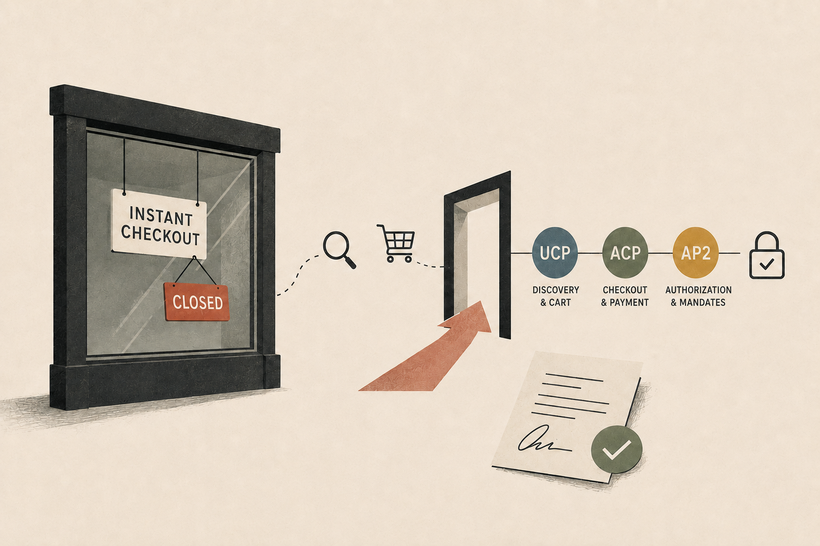
In September, OpenAI switched on Instant Checkout: you could buy without leaving ChatGPT, with Etsy and Shopify alongside and the promise of more than a million merchants to come. In March 2026, it switched it off. Five months.
The answer was in plain sight, inside the product. My surprise is that it lasted that long. You could buy one item at a time, and only from Etsy sellers in the United States. The basics of the experience were missing: multi-item carts, promotional codes, a delivery date, and state sales tax was not even fully wired in. At its peak, around thirty stores, by most accounts, out of Shopify's millions. What follows is a look at the failure of the year in what people call agentic commerce.
Why it failed
The first thing you would reach for: people do not want to buy through AI. The numbers say otherwise. Walmart measured checkout inside ChatGPT converting roughly three times worse than a plain click through to walmart.com, and at the same time saw ChatGPT bring in about twice the new-customer rate of traditional search. The two numbers are interesting precisely when you read them together: discovery worked, the transaction did not. People researched in the chat and went to buy somewhere else.
Underneath sat a problem that is both more technical and more structural. Product data on the web is a mess. Every shop describes its stock its own way, prices move without warning, tax rules change from state to state, and none of that automates without shortchanging somebody along the way. The distance between showing a product and processing a sale has inventory, returns and loyalty inside it, and that distance was underestimated.
What came out of it is a pattern that looks durable to me: discover in AI, buy on the seller's own site. OpenAI itself moved to an apps model (Instacart, Target, Booking.com inside ChatGPT) that routes the user out.
What is left standing
Almost all the coverage treats the protocols as rival brands you have to pick between. They are layers of an ordinary purchase, and they stack: find the shop, build the basket, prove you are allowed to pay, move the money. UCP, from Google and Shopify, handles discovery and the cart. ACP, from OpenAI and Stripe, handles checkout, and survived the death of the product that introduced it. AP2 handles authorisation. A single purchase can use three at once.
The new piece is in AP2, and it is the one thing in this text I would ask you to keep. Bots have bought and scraped websites for years; what never existed was a way for an agent to prove it was authorised to do so. AP2 turns every purchase into a set of signed mandates: what I want and within what limits, what the agent put in the basket, what will be charged. In practice my mandate says "buy running shoes, size 44, up to 150 euros, white or grey, to my address", and the agent cannot step outside that without asking again. The merchant and the bank can verify the signature without having to trust anyone in between.
This is no longer one company's project. On 28 April 2026, Google donated AP2 to the FIDO Alliance, the same body that standardised passkeys, with sixty organisations joining. That is the usual route for a piece of payments infrastructure that is here to stay.
The honest picture
That said, almost none of this has reached the average consumer. Buying inside the conversation retreated, and it carries a conversion penalty you do not fix with a patch. Amazon kept its ecosystem closed, with an assistant of its own and OpenAI's crawlers barred from the catalogue. The number everyone cites, McKinsey's estimate of 3 to 5 trillion dollars by 2030, refers to commerce that is influenced, and "influenced" widens considerably what that number actually means. And agent identity is still open: the first quarter of 2026 alone brought several documented attempts to hijack agents through prompt injection.
From my trenches
I write this from a concrete place, and in no hurry at all. A few months ago I worked on growth for a nursery that sells mature trees, where a sale involves visits to the field and weeks of conversation. Agentic checkout is not coming to that any time soon. It still touches me, and it touches you, only on a different layer.
If the pattern is discover in AI and buy on the site, the work for a small business today is not to integrate payments. It is three things that are less spectacular and much cheaper.
The first is making the data machine-readable: catalogue, terms, what the business knows, clean and in a format an agent can read the day it comes to route someone to you. It is the same discipline I wrote about with OKF, and nobody needs to wait for a protocol to start.
The second is handling the arrival well. The model that won sends the buyer to your site, and that is where the sale is made or lost. If that handover is confusing, the AI has only brought someone to see a closed door.
The third is measuring the right thing. Do not count purchases completed inside the chat, which is the part that stalled. Count AI-referred sessions and the new-customer rate, which is where the value sits and is invisible to anyone watching only in-chat checkout.
It is all housekeeping, and you can start on an afternoon. The question nobody can answer yet is the other one: the day an agent can prove it acts for me, within limits I signed myself, how much will I still want to decide by hand?