Updated
Query fan-out: every question you ask an AI engine is dozens of searches
Every question you ask an AI search engine branches into dozens of parallel sub-searches. It is called query fan-out, and it changes the unit you optimise content for: no longer the keyword, the whole topic.
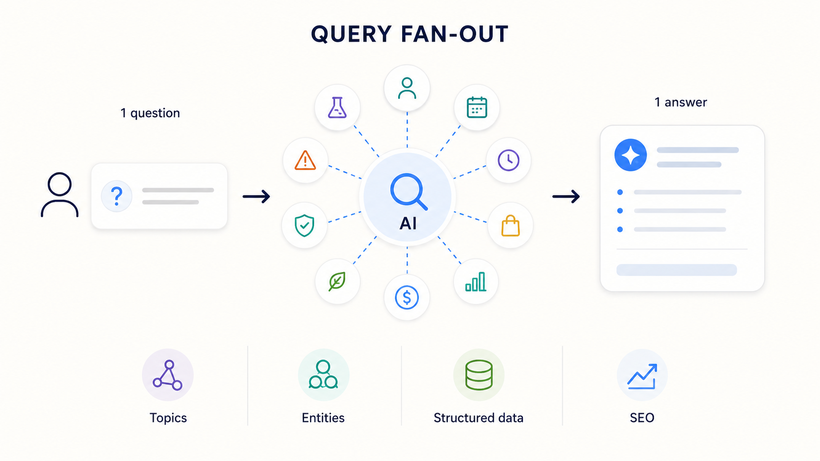
In AI Mode, Google does not search your question. It breaks it into subtopics, searches each of them in parallel, and assembles the answer out of what it finds. You type one sentence; the engine may run ten or twenty searches behind it, and in Deep Search, the slower version of the same mechanism, hundreds. It is called query fan-out. Google introduced the technique in May 2025, when it launched AI Mode, and now documents it in Search Central as something both AI Mode and AI Overviews may use. What changes is not so much the content you write, it is the unit you write it for.
What the engine does with your question
Take a question like "what skincare routine suits my 14-year-old daughter?". In an engine with fan-out, that can turn into separate searches about age, skin type, ingredients to avoid, risks and price, and a page that treats the whole topic with some depth stands a chance of appearing in several of those searches at once, while ten thin pages, each tuned to one keyword, compete alone in each. Classic SEO thought in terms of one query and one page. The prize here is different too: being one of the sources the engine uses to write the answer. And the term, although it is Google's, describes what ChatGPT, Perplexity or Claude do when they go to the web; they just never named it.
What fan-out is not
Hence the obvious temptation, which I would avoid. The sub-queries a tool can intercept today change from one run to the next (the same prompt, ten minutes later, branches differently), so they are not a new keyword list, nor the long tail under another name. Building a page for each variant is chasing a target that has already moved. What persists between runs are the topics and the entities, and that is what is worth optimising for. Without forgetting that ordinary SEO still filters at the door: if the page is not findable or relevant for the searches the engine runs, it never reaches the synthesis.
A decade of evidence, with none of it planned
I have run a two-sided US directory for over ten years, with thousands of pages of profiles, cities and specialities, and for much of that time keeping the data model (location, speciality and availability as separate fields, linked to each other) felt like over-engineering for a site that size. The easy alternative was everybody else's: thin pages to catch the long tail. I did not take it because the model made sense for the product, not because I foresaw anything.
Today, when someone searches for "professional near X who does Y and is available at weekends", every piece of that question already exists as data. No page was built for that sub-query. The whole system answers by parts.
What I would do today
Starting now, I would do the same thing in less time: consolidate thin pages into one well-covered topic, link content that talks about the same thing, and turn into explicit data, and into structured data, the attributes people actually filter by. The question I will leave you with is simpler than it looks: of the pages you have today, how many answer a topic, and how many answer only a keyword?