Updated 6 min read
The standard that is just a folder (and why it should matter to you)
An organisation's knowledge lives spread across WhatsApp, spreadsheets and two people's heads. Google's new standard gives that problem a name, and the work it forces is worth more than the format.
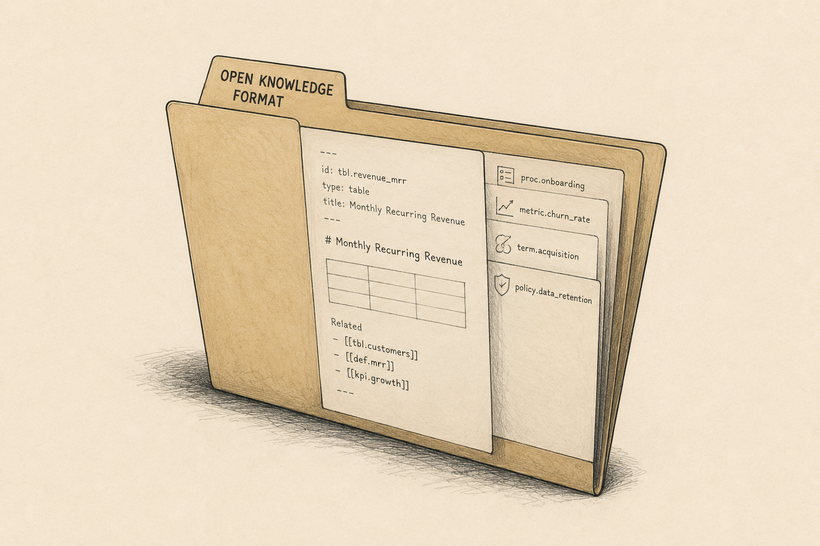
Google published a specification a few weeks ago that, looked at closely, is a folder of text files. No database, no server: markdown files inside a folder. It sounds too plain to matter. It matters because it names a problem plenty of companies already have and nobody had standardised: where does an organisation's knowledge live, and can a machine read it?
What it is, plainly
It is called the Open Knowledge Format, or OKF. The first version came out in June under an open licence, and it is already at v0.2, which tells you how early we are.
The idea fits in a sentence: represent an organisation's knowledge as markdown files, each describing one thing (a table, a metric, a procedure), with a structured header at the top and ordinary text below.
If you have ever used Obsidian, a wiki, or a well-kept folder in Drive, the shape is familiar. That is deliberate. Markdown is plain text: a human reads it in any editor, an AI model reads the same file with no conversion in between. Files link to each other with ordinary markdown links, which lets an agent see not just the pages but how they relate, a small knowledge graph in its low-tech version.
The problem it solves
Think of everything you need to know to run a business that is never written down in one place. The exact meaning of a metric. How two systems talk to each other. What to do when something breaks. That knowledge lives scattered: a bit in a catalogue, a bit in a wiki, a bit in code comments, and a lot of it in one or two people's heads.
When you build an AI assistant to answer "how do I calculate this?", it has to stitch the answer together from fragments in different formats. Google calls it the context-assembly problem. The observation behind OKF is almost banal: dozens of teams are solving the same thing, each in its own way, and a common format would save the work.
The honest picture
First, what OKF is not: SEO. This will tempt anyone who works in search, and it is a trap. OKF is not a ranking signal, and a bundle will not move your traffic this week or next.
The serious criticism is a different one: OKF solves the format, not the meaning. Agreeing on the layout (folders, files, fields) is relatively easy. Agreeing on the sense, on what each type of thing denotes and how two entities relate, is much harder, and OKF does not try. Two perfectly valid OKF folders can use different vocabularies for the same reality, and a link says two concepts touch without saying how. That is deliberate: OKF imposes no ontology, and people are already exploring semantic layers on top of it.
Then there are the risks. A knowledge base an agent updates on its own is also a way in: if the agent writes from sources you do not control, the folder can absorb instructions or information that should not be there. v0.2 starts to answer with provenance and verification mechanisms, but it is worth deciding early who may write into the base, and whether that "who" includes machines.
And the usual caveat with Google: the format is open and needs no Google account, but most of the reference tooling is born inside Google Cloud, and the convenience of using what is already there ends up weighing.
From the trenches
This is where it stops being theory. This site already works a little like that. The assistant that answers visitors, ROMEO, reads a folder of markdown files versioned in git: one file per topic, with the same name in Portuguese and in English, and every section written to be read on its own by a machine. And everything I learned getting the site running (the Wagtail traps, the incident where the site served a July copy of itself for hours, the rules not to break again) lives in a file the coding agent reads before touching a line. Before that, the knowledge was where it is almost everywhere: in my head.
OKF puts a concrete question to me: what if this stopped being my own arrangement and followed a shared format, one that another tool could read without me explaining anything? That is the scenario the format was designed for, at the scale of someone working alone.
And you do not need a site with an assistant to have this problem. Picture a fine-art museum in Porto. The staff coordinate over WhatsApp. The opening hours live in a Word file someone updates now and then. The terms of a loaned artwork sit in a PDF from 2019, in the inbox of someone who has since left. The inventory is in one Excel sheet, the school-visits policy in another, and the website runs on a control panel nobody is quite sure who administers. The knowledge exists. It is just spread across half a dozen tools that do not talk to each other.
The day that museum wants an assistant on its website, it hits a wall. There is no organised source for the assistant to lean on, and the result is familiar: it invents opening hours, misquotes the terms of a loan, contradicts the group policy. The OKF logic would be to start by tidying that knowledge up: a file for ticketing, one per exhibition, others for loans and procedures, all linked. Even if the chatbot never exists, the exercise forces someone to find out where the information is, which version is the right one, and what lives only in one person's head. The exercise is probably worth more than the chatbot.
The long view
So is it worth it? The format itself is not urgent. It is very new, it went from 0.1 to 0.2 in weeks and will move again, and if you put your knowledge into markdown today and the world converges on something else, the migration is the least of your problems. The work underneath stays done whichever format wins: making explicit and machine-readable what today lives scattered between people and systems. The Porto museum needed that work before Google published OKF and will still need it in three years.
The most valuable thing about OKF is that it gave a name to a layer that was missing, and put on the table a job many organisations keep postponing. The technical depth is deliberately small, and that does no harm at all.
How much of your organisation's knowledge would disappear if the right person left tomorrow? And of what remains, how much can a machine read?