7 min read
Back to ChatGPT. The method I wrote in Claude can come with me
ChatGPT and Codex now share a plugin directory, and the format those plugins store instructions in is the one Claude reads. What that changes for marketing work, with a demonstration still to be run.
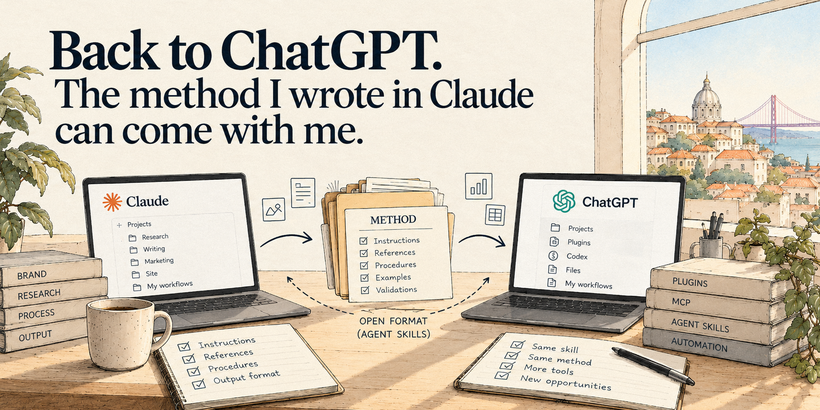
I built part of this site with Claude's help. That was where I worked out what I could build with artificial intelligence (AI) and how to fold it into my work. Codex, OpenAI's coding agent, already existed and stayed outside that experience.
I have tried it now, and I could feel how far it had come. I went to the documentation to see what had changed, and the plugins were what held my attention. A plugin stores a working method in writing, gets installed, and is used again on the next request. The format it stores that method in was created by Anthropic, the company behind Claude, and is now an open standard that ChatGPT and Codex read too.
What is a plugin, in plain terms?
A plugin is the folder you hand a new colleague on their first day. Inside are the instructions for the job (what to consult, in what order, what the finished piece must contain) and, where they are needed, the keys to the systems that colleague will use.
OpenAI's documentation names the two parts. The instructions are a skill: a folder with a text file that says when it applies, which steps to follow, how to handle incomplete results and what the final deliverable looks like, alongside the reference documents. The keys are an MCP server (Model Context Protocol, the open protocol that connects AI to outside tools and data), and that is how live data and actions in other systems come in. It is the route I used when I gave an agent the keys to this blog. The plugin is the package that holds one part, the other or both, and that people install and share. It can carry instructions alone, and for a lot of marketing work that is enough.
What did OpenAI ship, and when?
Plugins reached Codex on 25 March 2026. The rest is recent. On 29 September, at the company's annual conference, the GPT-6.1 Sol model arrived in Codex and ChatGPT Work, and plugins gained Plugin Extensions: sidebar apps, panels beside the conversation, file viewers and editors, forms. A faster variant of the same model followed on 8 October.
ChatGPT Work is the mode for delegating tasks that end in a deliverable: a presentation, an analysis, a spreadsheet, a brief. You follow progress, answer questions and approve the important actions. Codex, in its command-line version, reads files, edits them and runs commands on the machine where it is installed. The two share a single plugin directory.
As for the model, OpenAI presents it as close to its top model on complex work and cheaper, suited to repeated, long-running work, with availability depending on the plan. The numbers behind that sentence are the company's own evaluations. For my work, what counts is what my own tests show.
What travels between tools, and what stays put?
The skill travels. The format is called Agent Skills; it began at Anthropic, was published as an open standard, and the list of compatible clients now includes Claude, ChatGPT and Codex, Cursor and GitHub Copilot. August 2026 brought Agent Plugins as well, a shared format for packaging skills and MCP servers, maintained by people from Amazon, Cursor, Microsoft, OpenAI and Vercel.
What stays tied to each tool is the connections to other systems, with their authentication, and the panels. A plugin with its own panel in ChatGPT needs fresh work to exist anywhere else, and the critics quoted by The New Stack point out that the standard leaves permissions and installation policy to each client.
It pays to know where the things you install come from. In February 2026, Snyk audited 3,984 skills in two public registries and found at least one critical flaw in 13.4% of them and a confirmed malicious payload in 76. (Snyk sells scanning tools, and the study covers open registries, outside OpenAI's directory.) Installing a stranger's skill means running a stranger's instructions. The ones we write ourselves carry a quieter risk: a plugin faithfully repeats what is in it, incomplete instructions and out-of-date references included.
What would a marketing demonstration look like?
Picture a small Portuguese ceramics brand that wants to promote a collection in Portugal and Spain. It is a made-up example, built for a demonstration.
There are three documents. The brand book sets out the positioning and tone of voice, with sample copy. The product sheet lists prices, materials and confirmed features. The brief names the goal, the audiences, the channels and the budget. The task is to prepare a campaign proposal, two social posts and an email, with versions for both markets.
We can start in an ordinary conversation, with the documents and the procedure explained by hand, and then store that same procedure as a skill inside a plugin. The instructions would run along these lines: consult the materials before proposing the campaign, flag missing information, back every product claim, deliver in a set format and mark what needs human sign-off. One concrete rule: if the product sheet leaves dishwasher compatibility blank, the copy leaves that feature out of the selling points. Another: prepare the proposal for approval and stop there, before anything is published.
The test starts with the second brief
The first campaign may well come out convincing, and it proves little. A stored procedure earns its keep when the request changes.
In the second brief, the same brand wants to promote a different product, in Spain only, on a smaller budget, and shipping costs are left blank on purpose. The point is to see whether the AI adapts the proposal, keeps to the brand's criteria and stops to ask about shipping. I would use the same documents, the same instructions and the same model for both ways of working, and record preparation time and the number of corrections, with factual errors counted separately. Sales sit outside this measurement: a well-presented campaign only demonstrates them once it has run.
This test has yet to be run. When I run it, the results go on this page, with what worked and what needed correcting.
The method is the part that stays
The method I use to write these articles lives in a skill: research first, an internal dossier, every date checked against its source, and only then the text. I wrote it for Claude. According to the specification, the same folder can be read by Codex, and that is where I want to start: take it across exactly as it is and see what gets through and what breaks.
Preparing a campaign involves choices that tend to stay scattered across documents, conversations and the memory of whoever made them (the AI Council I wrote about here is another procedure put in writing). Writing them into a skill puts part of the method in plain view, where it can be reviewed and corrected with each new case. This is where the change meets the question that guides my work: how far can one professional, working alone with AI, deliver what is expected of an agency? The answer depends on the quality of the processes that person can define and supervise, as much as on the quality of each deliverable.
Models change by the month, and in September they changed twice. The folder of instructions stays the same. Which parts of our work can we explain precisely enough to fit inside it?