Updated 5 min read
How to build an AI Council in Claude: 5 personas for better decisions
A practical prompt engineering guide to personas, multi-perspective prompting and synthesis in Claude, without turning any of it into a multi-agent system.
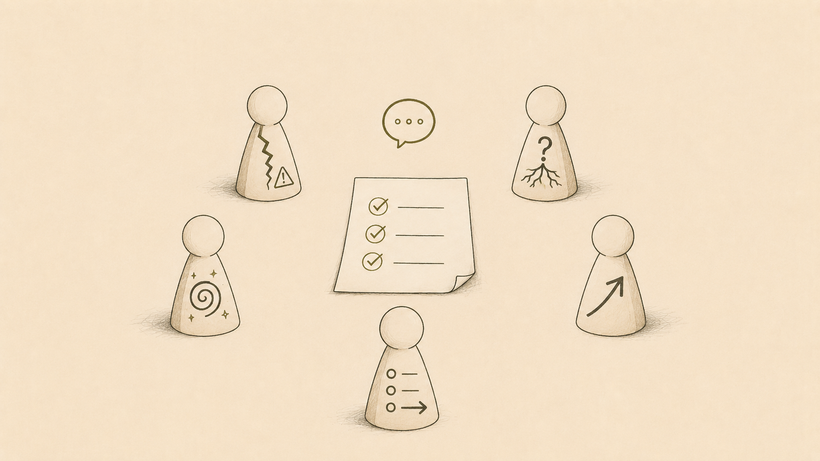
There is a kind of AI answer that particularly annoys me: the one that is technically correct and helps with nothing. You ask whether you should raise a price or hire someone, and you get four balanced paragraphs on advantages, risks and "factors to consider". At the end, the decision is still sitting there, untaken.
A prompt engineering technique I have been using to escape that is what many people call an AI Council: asking Claude to analyse the same decision through several personas before producing a conclusion. It also goes by names like role prompting or multi-perspective prompting. The name matters less than the idea.
This is not five agents, nor a multi-agent system, nor several different models answering the same question. It is one model, simply forced to look at the problem from different positions before it answers.
And the fun part is choosing who sits at the table.
The five personas in my AI Council
The Contrarian is that slightly annoying person who finds the hole in the plan when everyone else was already excited. Their question is simple: where does this break? And what am I underestimating because I am too close to the problem?
The Fundamentalist refuses to accept the question as it came. Ask "should I raise the price?" and they may answer that the problem might not be the price at all.
The Ambitious One does the opposite: they assume for a few minutes that the idea works and ask whether you are thinking too small.
The Outsider comes from elsewhere. They try to look at the problem the way a hotel would, or an airline, or a supermarket, someone who does not know the rules of your sector and therefore does not know what "isn't done".
The Executor is already tired of the conversation (probably rightly). They want to know what we do on Monday.
Then a sixth function comes in, and it does not even need a personality: the synthesis. The model reads the five perspectives and answers three things: what it would do, what the biggest risk is, and what the first step is.
The prompt to create an AI Council in Claude
It does not need to be sophisticated:
Help me think about this decision from five perspectives.

1. Contrarian
 Look for the weakest point of the idea. What am I probably underestimating?

2. Fundamentalist
 Question the question itself. Am I trying to solve the right problem?

3. Ambitious One
 If this works, what is the bigger opportunity I might not be seeing?

4. Outsider
 Bring a perspective from another sector or way of thinking.

5. Executor
 Say what you would concretely do next.

I want them to disagree with each other when it makes sense.

At the end, produce a synthesis and answer:

* what you would do;
* what the biggest risk is;
* what the first step is.

The decision is:
[write it here]
You can use this in a normal Claude conversation. If you end up using it often, you can also store the instructions in a Claude Project or other persistent instructions and change only the question.
I would not do that straight away, though. First I would test it.
The first prompt is probably not the best one
Personas always look better on paper than in practice.
Try the AI Council on a real decision. If the Contrarian only invents generic risks, it needs tuning. If the Ambitious One keeps suggesting you "turn this into a platform", so does that one. If the Outsider keeps reaching for Apple analogies, fire them. And if all five arrive at essentially the same conclusion in different words, go back to the instructions and change them.
That is how I treat this kind of prompt: I test it, see where it fails, and keep tuning it for the kind of decisions I actually make.
The personas can change too
The five above work well for general decisions, but there is nothing special about those five names. For a financial decision I might want someone obsessed with the numbers; for product, someone whose only job is to represent the customer; for a brand decision, perhaps a persona that only ever asks "does this sound like us?". And for a technical decision I might swap out half the table.
If two personas are looking for the same thing, one of them is redundant. The funny names are just packaging.
When an AI Council helps
I would not use this for factual questions. If I want to know how much I paid for something, I do not need five opinions.
I use it when there is a decision where several answers seem reasonable. Price is a good example. Hiring someone too. Choosing between two projects. Deciding where to start digitalising the company. Deciding whether something that has already eaten too much time deserves to continue.
And I still do not treat the conclusion as truth. An AI Council in Claude does not create five independent experts. For me it mainly serves to avoid that averaged answer where the model blends everything together too early.
Sometimes one of the personas says something I had not considered. Sometimes they all produce banalities. In that case I go back to the prompt and change it. That is part of it too.