7 min read
Where does a small business start with AI? With the people who do the work
The knowledge a small business needs to use AI already sits with its own people. Discover, plan, execute, update structures, in that order.
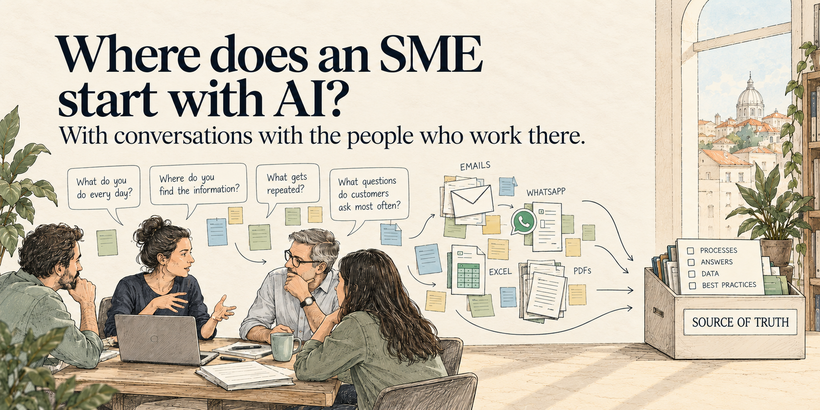
In 2025, Statistics Portugal (INE, the national statistics institute) asked Portuguese companies that do not use artificial intelligence why they don't. The most common reason was neither cost (60.4%) nor legal uncertainty (57.3%). It was a lack of relevant knowledge inside the company, cited by 74.4%. At first glance that reads as "we don't understand AI", and the obvious remedy looks like a training course. I read the figure differently. The missing knowledge is rarely about models; it is about the company itself: where the hours leak away, where information actually lives, which tasks get repeated every single day without anyone having written them down. No course teaches that, because it is held by the people who work there.
So in a small or medium-sized enterprise (SME), AI starts with a series of conversations.
What is holding small companies back?
Portugal lags, and its small firms lag further. According to INE, 11.5% of companies with ten or more people used AI in 2025, against a European Union (EU) average of 19.95% by Eurostat's count. Among firms of 10 to 49 people the gap widens: 9.4% in Portugal, 17% across the EU. (Micro-businesses, which make up most of the Portuguese economy, are not even in these figures.) The pattern holds beyond Portugal: in an OECD (Organisation for Economic Co-operation and Development) survey of more than 5,000 SMEs in seven countries, over half of those not yet using generative AI named a lack of skills as the obstacle.
Moving ahead does not guarantee a result either. A study from MIT (the Massachusetts Institute of Technology) published in 2025 found that roughly 95% of the generative AI pilots it examined showed no measurable impact on the bottom line. Treat that number carefully: the study is preliminary, the sample is small, and "no measurable impact" often means nobody measured the starting point. The diagnosis is the useful part. The authors call it the learning gap: the tools worked, but companies did not know how to fit them into real work, and the tools forgot context from one use to the next. The same study found staff using personal AI tools for work in over 90% of the companies surveyed, often without their employer knowing. The gains were real. They stayed with each individual and walked out of the door with them.
So where do you start?
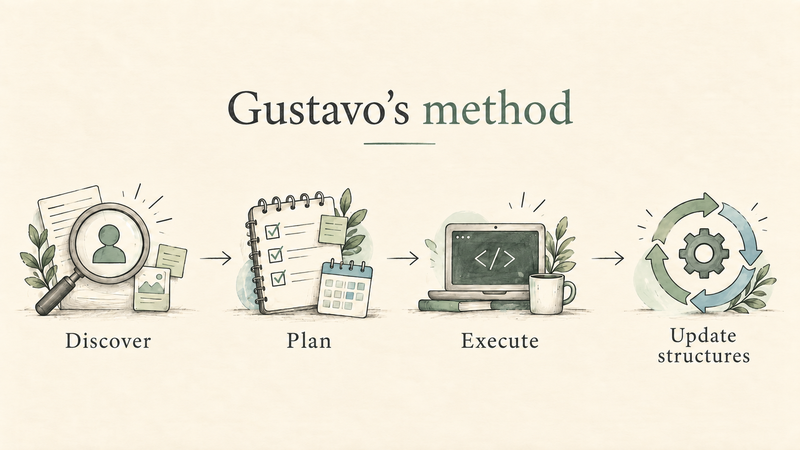
I work with a four-step method, always in the same order: discover, plan, execute, update structures. None of it is new (Lean manufacturing calls the habit of going to see where the work happens gemba). What has changed is the typical mistake. When the technology was expensive, small firms simply did not start; now that anyone can open ChatGPT on a phone, they start from the tool and skip the first two steps.
Why do the interviews come first?
Discovery means talking to everyone in the company, management included but not alone. Thirty to sixty minutes per person, about the actual work: what they do on a Monday morning, where they go for the information they need, what they copy from one place to another, which question customers ask them most. Management tends to describe the official process. Whoever answers the phone describes the real one, and the gap between the two is nearly always the first project.
The same conversations show where the data lives: in one person's head, in an inbox, in a WhatsApp group, in a spreadsheet that exists in three versions. (If your sales quotes live as PDFs lost somewhere between email and WhatsApp, I wrote about that here.) This matters for privacy, a concern 55.4% of firms without AI raised with INE. Before any tool touches customer data, the company needs to know what data it holds, where it sits, and which of it must never leave the building. That privacy boundary gets drawn here, in the first step.
One condition makes all of this work: the interview must not feel like an appraisal. If the team suspects someone is measuring who works least, they will hide exactly the repetitive tasks you came to find.
How do you pick the first AI project?
The interviews produce a list of pain points, ranked by how often they come up and how much time they cost. You pick one. Two at most. (When two pain points look equally urgent, an AI Council helps break the tie.) Before changing anything, you measure for a week or two how many requests come in and how many hours they take to handle. Without that baseline, three months later nobody can say whether the project worked, which is precisely how companies end up in the 95%.
Execution is a short pilot, four to six weeks, inside the workflow that already exists and with the people who will use the tool day to day. Only now do you choose the tool, and the model too (I wrote a beginner's guide on that). The MIT study offers a figure more useful than its famous one: solutions bought from specialist vendors succeeded in about 67% of cases, internal builds in about 22%. A small business rarely needs to invent anything. It needs to know what to buy and where it fits.
What does updating structures mean?
It is the step almost nobody takes, which is why so many pilots die. The pilot goes well, the enthusiasm fades, the person who ran it moves to another role, and six months later the tool sits forgotten in a browser tab. Updating structures means that what was learned now lives in the company rather than in one person. Procedures get rewritten, each with a named owner. The knowledge that sat in heads and chat threads moves somewhere both people and machines can read, which is what I call a source of truth (Google published an open format for exactly that this year). This is the step that turns one person's private AI habit into a capability the whole company owns.
What does this look like in practice?
At an ornamental-tree nursery where I ran a growth engagement, the prototype for customer emails drafted replies within fixed limits (never quote prices, never confirm stock without a caveat, reply in Spanish to anyone who writes in Spanish), and each qualified email added one or two new questions and answers to the knowledge base. Those limits came from the people who answer customers every day.
I applied the same method to myself. Before building ROMEO, the assistant on this site, I wrote down the 42 questions a visitor would ask it and answered each one in writing. The technology came afterwards. That is why it can say "I don't know" when a question strays beyond what is written.
What can an SME do this week?
The first step costs a few hours of conversation. Pick the three people in the company who talk to customers most and ask them what they do every day that they would happily never do again. Write the answers down as they say them. Notice how often the same task or the same customer question comes up, and in how many different places the information to answer it is kept. That is the map. When the tool arrives, it will know where to go.
How many of those answers are written down anywhere today?