8 min read
The source of truth: your company in a folder of markdown files
AI is only useful when it knows where the company's truth lives. Not a vector database, not a new standard: a folder of text files that someone has the authority to keep true.
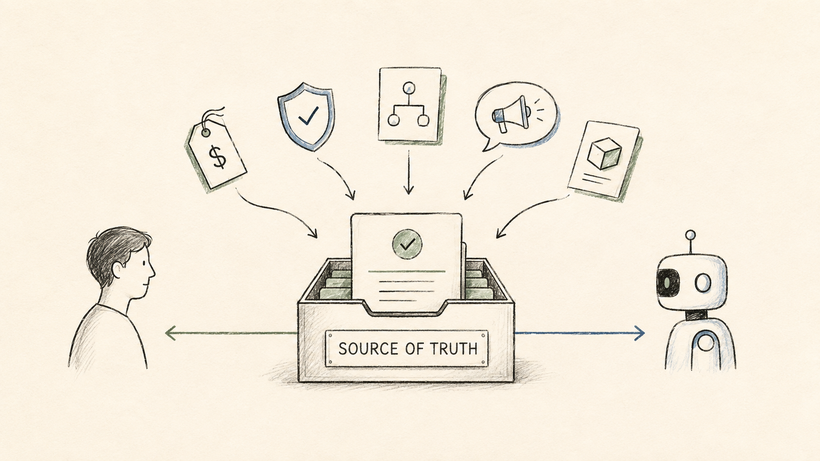
Without a shadow of a doubt, the most useful document in my master's thesis was not one of the chapters. It was a repository I called the brandbook. Every marketer knows the concept, but mine had become something slightly different: the place where I pinned down everything that was true about the micro-SME I was transforming as my case study. The communication came out of it. The targeting came out of it. So did the funnel. Today I would probably give it a different name (source of truth), and back then it had one kind of reader: a human.
On 12 June this year, a specification called the Open Knowledge Format appeared in Google Cloud's public Knowledge Catalog repository, and at its core it is remarkably simple: markdown files with a small metadata block, one concept per file, links between related concepts. It reminded me immediately of that brandbook, with one difference. There is now another reader at the table: the machine.
My friend TJ Robertson, who runs an AI SEO agency in Nevada, arrived at roughly the same place through daily operations. At TJ Digital, every client has a Brand Ambassador, a set of markdown files containing the authoritative facts about that brand, and agents consult it before they write a line. Different routes, same conclusion: AI is far more useful when it knows where the company's truth lives.
What I mean by a source of truth
The term itself is not new. Companies have had sources of truth for decades: an ERP, a CRM, a product database, sometimes just a spreadsheet everyone knows not to touch. What I mean here is slightly narrower: a curated corpus of confirmed company knowledge that AI systems read before producing an answer. Prices, policies, working methods, history, brand voice, who does what, what the company sells and what it refuses to sell.
For the systems I build I like plain files, usually markdown: readable by humans, easy for models to parse, easy to move between systems and trivial to version in git. That last part matters more than it sounds, because truth has versions. A price that was correct in January may be wrong in June, and with version control you can see what changed, when it changed and what the previous answer was, without buying a knowledge-management platform to get it. The exact format matters less than the discipline behind it.
The problem it solves has a name: guessing
In September 2025, OpenAI published the paper "Why Language Models Hallucinate". Its central argument is straightforward: training and evaluation systems tend to reward guessing over admitting uncertainty. Think of a student in an exam. If leaving a question blank guarantees zero points, guessing becomes the rational strategy, and language models grew up inside systems with similar incentives.
Now apply that to a company. Ask an AI assistant about your delivery times without giving it access to your actual delivery policy, and it may say it does not know, but it may just as well produce something perfectly plausible based on everything it has seen about companies like yours. That is what makes the mistake dangerous: the wrong answer does not look wrong.
The rule I use has three steps. Facts about the company come from the company's authoritative corpus. Facts about the outside world, such as competitors, regulation or market data, come from external sources and get cited. If neither contains the answer, the system says it does not know, and that third step is surprisingly difficult to enforce consistently.
What a source of truth is not
It is not llms.txt, the public pointer meant to help AI systems navigate a website. Ahrefs analysed 137,000 domains in its Web Analytics dataset and found llms.txt on 28% of them; of those, 97% received no requests at all during May. The file is not the interesting part. Publishing a pointer takes ten minutes, while deciding what is true about your company, structuring it and keeping it accurate is the actual work.
It is also not a cure for hallucination. An authoritative corpus removes most of the model's reasons to improvise about company facts, but it can still misunderstand a document, retrieve the wrong file or combine two facts incorrectly. So you test it. My starting point is deliberately unsophisticated: twenty questions whose answers you already know, run against the system after significant changes to the corpus. Did the answer come from the files, did it retrieve the correct one, did it invent anything? You do not need an elaborate evaluation framework to discover most of the early failures.
What happens when it gets large?
People often ask what happens when the source of truth outgrows the context window. Ideally, nothing. The agent should never read the whole repository at once: it first gets a map of what exists, then opens only the documents relevant to the task. Anthropic uses the term progressive disclosure for a similar pattern in Agent Skills, and the metaphor is less exotic than the technology makes it sound: you read the table of contents before opening a chapter.
MCP (the Model Context Protocol) gives the access side a standard: a repository exposed to any agent through a few simple operations (list, search, read). But transport is not the difficult part. I have seen repositories with hundreds of files where search technically works and the system still performs badly, because the documents are poorly named, overlap with one another or contain outdated information. An API cannot fix bad information architecture. The corpus still needs descriptive names, sensible boundaries between topics, useful metadata and somebody responsible for keeping it current.
The interesting part is not technical
In a real company, documents contradict one another. The March proposal says one price, the April price list says another, and a salesperson still quotes a third because nobody told them it changed. The model should not decide which one is correct; a person has to, someone with the authority and the context to say which number is actually true.
I saw this very clearly at an ornamental-tree nursery where I ran a growth engagement. Much of the knowledge that actually mattered, including the company's method and thirty years of history, lived in the heads of two people, and turning it into something an AI system could reliably use involved interviews, editing, and occasionally going back to ask: "You said X yesterday, but this document says Y. Which one is actually true?" Very little of that was an engineering problem. The harder skills looked much more like editorial work: extracting tacit knowledge, noticing contradictions, deciding how concepts should be separated, writing useful descriptions, testing whether answers are correct and deciding who has the authority to change them. Someone also has to own the repository, because without an owner it starts decaying almost immediately.
A broader pattern
Several parts of the AI ecosystem have been drifting towards similar primitives. Anthropic's Agent Skills use folders of markdown loaded progressively, AGENTS.md gives coding agents local instructions, and people have been running Obsidian vaults and home-grown LLM wikis for much the same reason. These things are not identical and they solve different problems, but the recurring preference is for something surprisingly boring: files, plain text, metadata and selective retrieval. There are good reasons for that. They are portable, humans can inspect them, machines can read them, git can track them, and you are not locked into whichever AI platform happens to be fashionable this year. Sometimes boring infrastructure is exactly what survives.
Where to start
Not with MCP, and not by choosing a vector database. Start by writing down the ten or twenty things your company repeats constantly: what you sell, who it is for, what it costs, on what terms, what you do differently, and which promises you are actually willing to make. Put each topic in its own file, give the files clear names, put them in git, and decide who owns them. The first version fits in an afternoon; the difficult part comes afterwards, because someone has to keep it true.
A few months ago I wrote about MCP and how I wired my own site to agents through it. This is the layer that comes before that: first you decide where the truth lives, then you decide how machines get access to it.
So where does the truth live in your company today? If the answer is "in the head of the most senior partner", you have probably found both a risk and your next project.