Updated 7 min read
What is Claude, and which model should you pick?
Two new models in one week, and Claude's menu has changed again. Version numbers come and go; the four tiers stay. A beginner's guide to picking the model by the task.
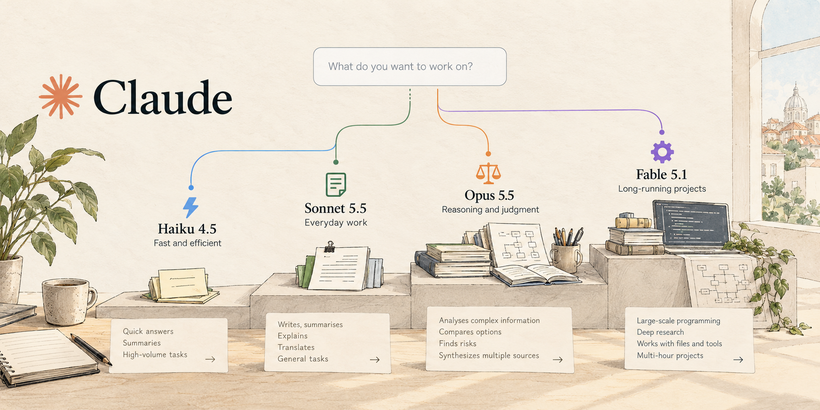
On 22 September Anthropic released Opus 5.5. Six days later came Sonnet 5.5. Anyone who opened Claude this week found a menu with different numbers from the week before, and the question every beginner asks (which one do I use?) got a little harder to answer.
The short answer is that the numbers matter less than they look. Claude has four tiers, and they hold from one version to the next: a fast one, an everyday one, one for work that needs judgement, and one for long projects. You pick the tier by the task, and the version is whatever the menu shows that day.
What is Claude?
Claude is the artificial intelligence (AI) assistant made by Anthropic, a San Francisco company founded in 2021 by former OpenAI researchers. You use it like a written conversation: ask a question, paste in a document or an image, and it answers. It runs at claude.ai in the browser, in desktop and mobile apps, and, for people who write software, through an application programming interface (API) that lets other programs use it without the app. It arrived in the European Union (EU) in May 2024.
Behind the app sits a family of models, and the model is what writes each answer. Think of the app as an office and the models as the people who work there, each with their own pace and their own rate. The menu under the text box is how you choose who you are talking to.
What are Claude's models?
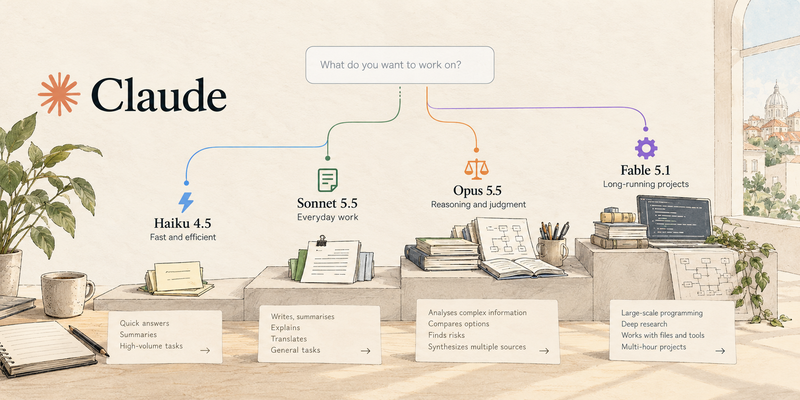
There are four today, according to Anthropic's models page. Haiku 4.5 is the fast one: short answers, summaries, repetitive jobs in bulk, where speed matters more than depth. Sonnet 5.5 is the everyday model; it writes, summarises, explains and translates well and quickly, and it is where most people should start. Opus 5.5 thinks more carefully, and earns its place when there is a decision with risks attached, a long document that has to be right, or several sources to reconcile. Fable 5.1, at the top, is built for projects that run for hours with Claude working on its own, such as large programming jobs or long research. (There is a fifth name, Mythos, which is the same model as Fable with looser safeguards, open only to vetted cybersecurity and life-sciences professionals. For a beginner it is trivia.)
Anthropic draws the line between Sonnet and Opus itself. In the Sonnet 5.5 announcement, the company says it lands two points behind Opus 5.5 on a real-work test, GDPval-AA, and adds that Opus remains clearly stronger at complex, open-ended work that needs sustained judgement. For an email, you will barely notice. For choosing between three suppliers, you will.
The version numbers tell a story that matters little to a beginner. Sonnet 5.5 replaced Sonnet 5 at the same price and, by Anthropic's account, uses less per task. When a Sonnet 6 arrives, the advice in this piece stays the same.
Is there a Claude Haiku 5?
No. The Claude 5 generation shipped Opus and Sonnet and skipped Haiku, so the newest Haiku is still 4.5, from October 2025. The next one is announced: at the Sonnet 5.5 launch on 28 September, Anthropic wrote that Haiku 5.5 will arrive "in the coming weeks", built for high-volume, cost-sensitive work. Until then the fast tier is Haiku 4.5, and the rest of this piece stands.
How do I choose the right model for a task?
Look at the task and ask three questions, in this order.
Is it short, with a clear answer? Summarising an email, rewriting a paragraph, translating, explaining a term, pulling the figures out of an invoice. Sonnet. If it has to run hundreds of times a day through the API, Haiku.
Does it need judgement? Comparing three supplier proposals and saying which to take, reading a twelve-page contract for risks, turning loose meeting notes into a plan. This is where Opus pays for itself, because a wrong answer costs more than the wait.
Is it a project that takes hours, with Claude working alone, opening files and backtracking when it gets something wrong? Fable, and only if Opus falls short. For someone starting out, that is rarely the case.
Next to the model there is a second control, effort, which sets how much work Claude puts into each answer. More effort gives fuller, slower answers and burns through your plan's limits faster. The value that comes selected by default is fine for almost everything.
How much does Claude cost?
Starting costs nothing. The free plan gives you Sonnet and Haiku, with web search, file creation and memory, and it is enough to find out whether Claude suits you. Pro costs 20 US dollars a month before tax (17 dollars a month billed annually), roughly 18 euros plus value added tax (VAT) in Europe, and adds Opus, Fable, Projects and Claude Code. The Max plans, from 100 dollars a month, give five or twenty times Pro's usage and are for people who work with it all day. Companies have the Team plan, paid per seat, with central billing and admin controls.
No plan tells you how many messages you get, and that is the most common complaint about Claude. Limits are counted in five-hour windows and weekly, and bigger models use them up faster; Anthropic's own guide asks you not to put a big model on a simple task for exactly that reason. In January, developers complained of limits running out within minutes, and Anthropic put it down to the end of a holiday bonus (The Register). In practice: spend a week on the free plan. If you hit the limit, or the answers feel thin on tasks that need judgement, move to Pro and rerun them on Opus.
A note before you paste in documents. On personal accounts (free, Pro and Max), conversations are only used to train the models if you switch on Model Improvement in your privacy settings, according to Anthropic's privacy centre, and incognito chats are never used. Client data needs more care than that, and I wrote about it in Why does the model need this data?
Which model runs this site's assistant?
ROMEO, the cat in the corner of this site, answers questions about what is published here, and it answers with Opus. When I built it, Sonnet would have handled most questions at a much lower price. I chose Opus because ROMEO speaks for me, and a wrong answer about what I do costs me more than the difference on the API bill.
The cost is capped another way. Each answer is limited to 800 tokens (a token is roughly three quarters of an English word), the whole site has a daily ceiling of questions, and the API account runs on prepaid credits, which act as a spending limit. When ROMEO finds nothing on the site that answers the question, it does not call the model at all and returns a fixed message instead. The worst possible day has a known price before it happens.
With Sonnet 5.5 two points behind Opus, the switch deserves a test. The right test uses the checking questions ROMEO already has, because what matters is how each model answers questions about this site.
Where do I start?
Create an account at claude.ai and spend a week on Sonnet with real work: a difficult email, a report to summarise, a decision you keep putting off. Keep the answers that felt weak. If you move to Pro, rerun those on Opus and compare (the comparison teaches you more about the tiers than any table). To get more out of decisions, the AI Council is a simple technique that works on any model.
Three months from now the menu will show different numbers. Of the tasks you do today, which ones will still need the top tier?